
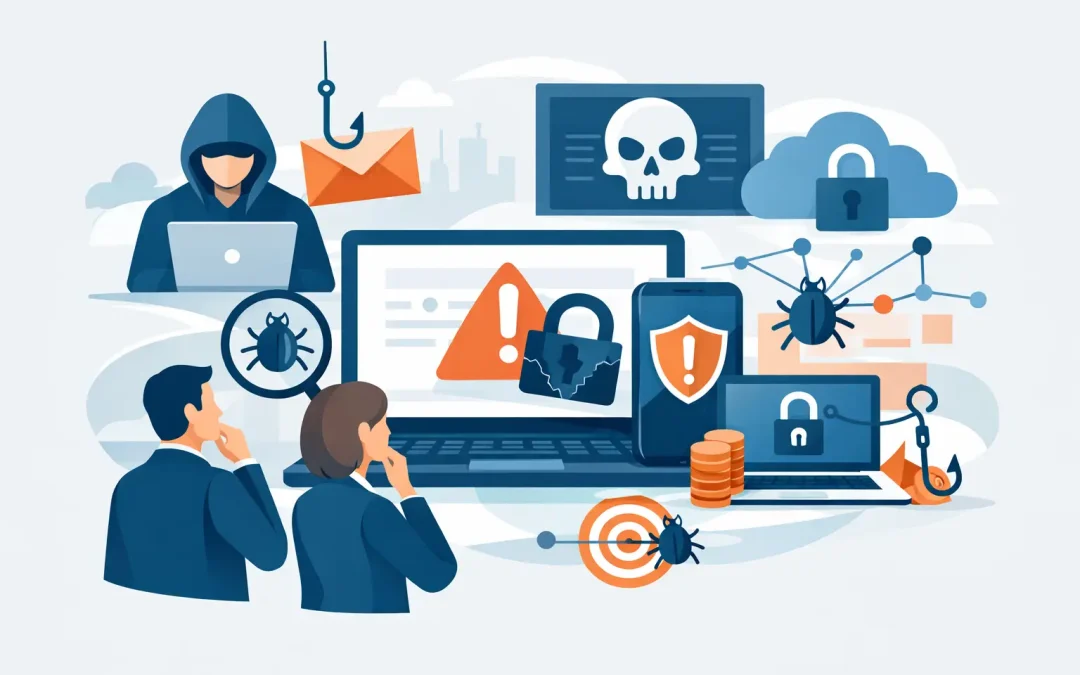
Top Cyber Risks for SMEs (and How to Reduce Them)
A single fake invoice, one reused password, or an unpatched laptop can stop a small business faster than many leaders expect. The top cyber risks for SMEs are rarely dramatic at first. They often look like ordinary day-to-day activity until someone cannot access systems, customers are affected, or money has left the account.
For smaller organisations, cyber security is not just a technical issue. It affects continuity, cash flow, client trust, compliance, and the ability to keep trading. Most SMEs do not have a large internal IT team monitoring systems around the clock, which is why attackers often target them in the first place.
In this article, we look at the most common cyber risks for SMEs and the practical steps businesses can take to reduce exposure.
Why Cyber Risks Hit SMEs Harder
A large enterprise may be able to absorb a cyber incident using dedicated security teams, spare infrastructure, and formal recovery plans. An SME usually has less margin for error. If finance systems go offline, if Microsoft 365 accounts are compromised, or if malware spreads across a server, the operational impact can be immediate.
That is why cyber risk should be viewed in commercial terms, not just technical ones. Lost productivity, delayed orders, reputational damage, and regulatory consequences can all follow from a single weakness.
The right response is not panic or unnecessary overspending. It is understanding where the real risks sit and putting proportionate controls in place.
1. Phishing and Social Engineering
Phishing remains one of the most common cyber risks for SMEs because it works. Attackers no longer rely only on obvious spam emails. They now mimic suppliers, delivery notices, internal approval requests, Microsoft 365 login prompts, and finance-related messages well enough to catch busy staff off guard.
For SMEs, this risk is increased by lean teams and fast-moving decision making. A finance manager may process supplier payments quickly. An administrator may reset credentials after what looks like a genuine support request. A director may approve a payment from a mobile phone between meetings.
None of this is careless in itself. It is simply how modern businesses operate.
The practical defence is a combination of email filtering, multifactor authentication, staff awareness, and clear internal processes for payments and account changes. Training matters, but it should not be the only control. People make mistakes, especially under pressure, so technical protection needs to support them.
2. Weak Passwords and Poor Access Control
Many breaches still begin with passwords that are easy to guess, reused across systems, or exposed in previous data leaks. SMEs often inherit this problem as they grow. Staff join quickly, old accounts remain active, shared logins persist, and permissions are granted too broadly because it feels convenient.
The risk is not only external attack. Excessive access internally can turn a small issue into a serious incident. If one compromised account can reach email, finance records, shared files, and cloud applications, an attacker has far more room to move.
Strong password policies, password managers, multifactor authentication, and regular access reviews can make a significant difference. So can removing dormant accounts promptly when staff leave or change roles.
This may not be the most exciting part of cyber security, but it closes one of the most common gaps.
3. Ransomware and Malware
When people think about cyber attacks, ransomware is often what comes to mind. It can halt operations within minutes, encrypt key systems, and leave businesses facing difficult decisions around recovery, reporting, and downtime.
For SMEs, ransomware is especially disruptive because recovery depends on preparation long before an incident occurs. If endpoints are not monitored, patches are delayed, backups are incomplete, or users have broad permissions, malware can spread further and faster.
In some cases, attackers now steal data before encrypting it, adding blackmail and reputational damage to the operational disruption.
There is no single product that solves ransomware risk. Effective protection usually combines endpoint detection, patch management, email security, network segmentation, and tested backup and disaster recovery arrangements.
The testing is important. A backup that cannot be restored quickly under pressure is not much use when systems are down.
4. Unpatched Systems and Ageing Infrastructure
Many SMEs run a mixture of cloud services, modern devices, and older on-site infrastructure. That is not unusual, but it does create risk. Unsupported operating systems, neglected firewalls, ageing servers, and missed software updates can give attackers an avoidable route in.
This challenge is not always caused by neglect. Sometimes the business depends on a legacy application, a specialist machine, or an old server that supports a critical workflow. Replacing it may require budget, planning, and downtime that the organisation has not yet been able to commit to.
Where immediate replacement is not realistic, the next best step is containment and visibility.
- Is the system isolated from the rest of the network?
- Is it monitored?
- Are access rights limited?
- Has the business documented the dependency?
- Is there a plan to replace or modernise it?
Cyber security is not always about achieving perfection straight away. It is about reducing exposure while moving towards a more secure and supportable environment.
5. Inadequate Backup and Recovery Planning
A surprising number of businesses believe they are backed up when what they actually have is partial coverage, inconsistent retention, or a recovery process that has never been tested properly.
That gap often only becomes clear after accidental deletion, hardware failure, or ransomware.
A backup strategy should reflect business priorities. Some organisations can tolerate a few hours of disruption. Others cannot afford to lose even half a day of orders, project files, pupil data, customer records, or communication history.
The right recovery setup depends on those realities.
This is where many SMEs benefit from external IT support. A managed approach helps ensure backups are monitored, failures are flagged, and recovery objectives are aligned with the business rather than assumed.
At CSLN Group, we often see organisations focus first on whether data is copied somewhere. The more useful question is how quickly systems can be restored and how much data loss the business can realistically tolerate.
6. Cloud Misconfiguration and Microsoft 365 Exposure
Cloud platforms have improved flexibility, resilience, and productivity for SMEs, but they are not automatically secure by default. Microsoft 365, file sharing platforms, and cloud infrastructure can all be exposed through weak settings, poor permission structures, or missing security features.
A common example is assuming that because data sits in a major cloud platform, backup, retention, and access control are fully covered. In practice, businesses still need to configure policies correctly, review sharing settings, protect accounts, and monitor suspicious sign-ins.
Cloud misconfiguration is a quiet cyber risk because nothing appears broken until there is an incident. A document shared too broadly, an inactive user left enabled, or multifactor authentication not enforced on one account can create a serious opening.
The cloud remains a strong option for most SMEs, but only when governance keeps pace with adoption.
7. Third-Party and Supply Chain Risk
Even if your own systems are well protected, suppliers can still introduce cyber risk into your business. Accountants, software vendors, outsourced service providers, telecoms suppliers, and connected partners may all hold sensitive data or maintain access to key systems.
This has become more relevant as SMEs rely on a wider mix of specialist tools and external providers. One weak point in that chain can affect invoices, payroll, customer records, or communication systems.
The challenge is that smaller organisations do not always have the time or framework to assess supplier security in a structured way.
A practical starting point is to identify which partners have access to what, confirm how that access is protected, and review whether it is still needed. For higher-risk suppliers, ask sensible questions about backup, incident response, access control, and authentication.
You do not need enterprise-level procurement bureaucracy, but you do need visibility.
How SMEs Should Prioritise Cyber Security
The top cyber risks for SMEs are not identical in every organisation. A school may prioritise safeguarding-related data and user access. A manufacturing firm may worry more about downtime on operational systems. A professional services business may focus on email compromise, confidentiality, and document access.
Sensible prioritisation starts with business impact.
- Which systems are essential to trading?
- Where is the sensitive data?
- What would stop staff working tomorrow morning?
- What would trigger a reporting obligation?
- What would damage client confidence?
Once those answers are clear, cyber security investment becomes more focused.
For most SMEs, the strongest early gains come from improving the fundamentals:
- Multifactor authentication
- Managed patching
- Endpoint protection
- Email security
- Tested backups
- Access reviews
- Staff awareness
- Monitoring and reporting
After that, more advanced controls can be layered in based on risk, budget, and business requirements.
Cyber Security Is an Ongoing Discipline
Cyber security should not be treated as a one-off purchase. Threats change, staff change, systems change, and businesses grow. Good protection is an ongoing operational discipline linked closely to IT support, infrastructure, compliance, and continuity planning.
A secure business is rarely the one with the most complicated tools. More often, it is the one that understands its weak points, keeps the basics under control, and has the right support in place before something goes wrong.
Need Help Reducing Cyber Risk in Your Business?
CSLN Group provides managed IT support, cyber security services, Microsoft 365 management, endpoint protection, backup solutions, and proactive monitoring for SMEs across the UK.
If you are unsure where your business is exposed, we can help you review your current setup, identify priority risks, and put practical controls in place to protect your systems, data, and users.
Contact CSLN Group today to discuss cyber security support for your business.
Contact CSLN Group – Reduce Cyber Risks in Your Business
If this article has highlighted areas where your business may be exposed, the next step is understanding how those cyber risks apply to your own environment. Many SMEs reach this point when they realise that gaps around access control, patching, backups, or Microsoft 365 security could have a real impact on day-to-day operations.
At CSLN Group, we provide fully managed IT support and cyber security services, alongside Microsoft 365 management, backup solutions, connectivity, and infrastructure. Our focus is on reducing risk in practical terms — securing systems, improving visibility, and ensuring your business can continue operating if something goes wrong.
Whether you need a full cyber security review, support strengthening your existing controls, or a managed approach to monitoring and protection, we take the time to assess your current setup, identify priority risks, and recommend clear, proportionate improvements.
With offices in Cambridge, King’s Lynn (Head Office), Norwich, and Birmingham, and the ability to support organisations across the UK, we combine fast remote response with dependable on-site support when required.
If you would like to understand where your business is most at risk and how to reduce that exposure, get in touch with our team for a no-obligation discussion or to arrange a cyber security review.
Effective cyber security is not about complexity. It is about controlling the basics, reducing risk, and having the right support in place before an issue becomes an incident.