
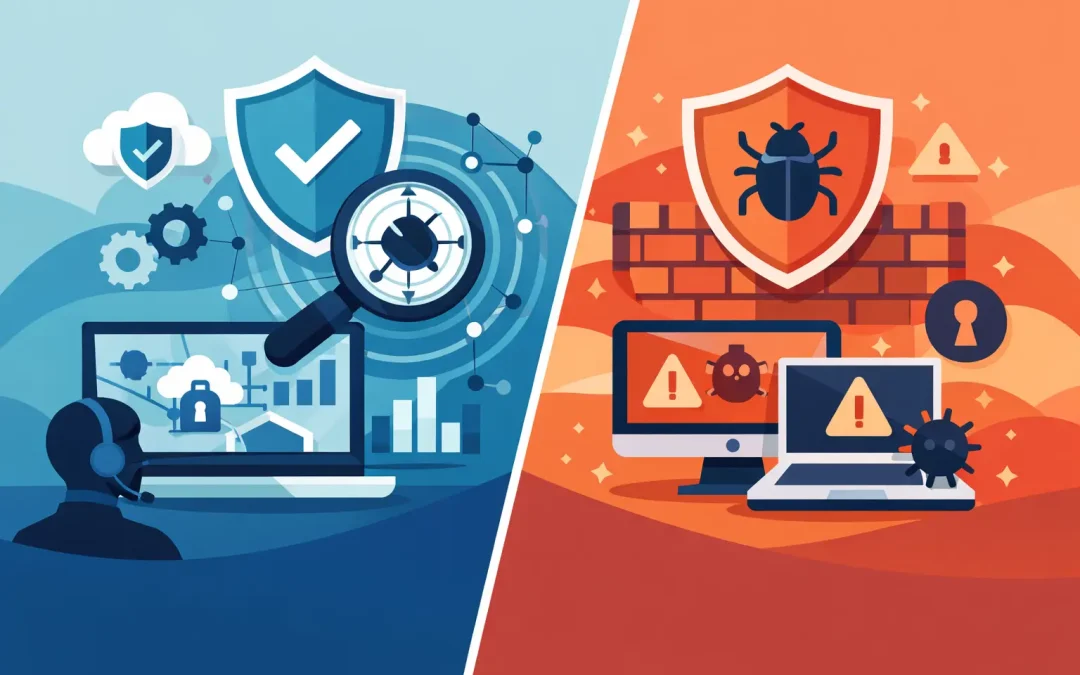
MDR vs Traditional Antivirus: What Is the Difference?
A ransomware alert at 2:13am is not the moment to find out your cyber protection only works when someone is sat at a desk watching it. That is the real difference in the MDR vs traditional antivirus debate. One is largely a tool. The other is a managed security service built to detect, investigate and respond when threats are already in motion.
For many organisations, antivirus was the default answer for years. It was installed on laptops and servers, updated regularly, and treated as a basic line of defence. That still has value. But the threat landscape has changed faster than many IT environments. Attackers now use legitimate tools, stolen credentials and low-noise techniques that can bypass software designed mainly to identify known malicious files.
MDR vs Traditional Antivirus at a Glance
- Traditional antivirus focuses mainly on blocking known malware and suspicious files.
- MDR (Managed Detection and Response) adds active monitoring, investigation and threat response.
- MDR helps organisations detect attacks that antivirus alone may miss.
- Traditional antivirus remains important, but most organisations now require layered protection.
MDR vs Traditional Antivirus: What Changes in Practice?
Traditional antivirus is designed to prevent malicious software from running on a device. It checks files, scans for known signatures and flags suspicious behaviour using predefined rules. For common malware and basic threats, that still provides value.
MDR, or Managed Detection and Response, goes much further. It combines endpoint monitoring technology with human analysis and active response. Instead of simply identifying suspicious files, MDR services monitor activity across devices, users and systems to understand what happened, how far it spread, and whether immediate action is needed.
That distinction matters because modern attacks rarely arrive as a single infected file. A phishing email may lead to a compromised Microsoft 365 account. From there, an attacker may create inbox rules, move laterally through the network, escalate privileges or access sensitive data. Traditional antivirus may never detect that activity if no obvious malware is executed locally.
Why Antivirus Alone Often Leaves Gaps
Antivirus still plays an important role, but relying on it alone can create a false sense of security. Most products are strongest at identifying known threats on individual devices. They are far less effective when attacks involve compromised credentials, cloud services or suspicious behaviour that only becomes dangerous when viewed in context.
This is where many SMEs, schools and charities struggle. They may have endpoint protection in place but lack the internal resource to investigate alerts, review anomalies or respond outside working hours.
If there is no one available to validate and act on suspicious activity, even strong security software can become little more than a warning light on the dashboard.
There is also the challenge of alert fatigue. Security systems can generate large volumes of notifications, many of them low priority or false positives. Without experienced analysts to triage them properly, important warnings can easily be missed.
Where Traditional Antivirus Still Makes Sense
It would be wrong to dismiss antivirus entirely. For very small environments with limited complexity and tight budgets, it can still form part of a sensible baseline. It also remains an essential layer within a broader cyber security strategy.
No serious MDR provider would recommend abandoning endpoint protection completely.
The real question is not whether antivirus is useful. It is whether it is enough for the level of risk your organisation faces and the speed at which incidents need to be identified and contained.
What MDR Adds Beyond Software
The most valuable part of MDR is not the acronym itself. It is the operational model behind it.
A managed service combines endpoint telemetry, threat intelligence, skilled analysts and response procedures. That means suspicious behaviour can be reviewed by people who understand what normal activity looks like, what malicious behaviour typically looks like, and what action should be taken first.
Depending on the service, MDR may include:
- 24/7 threat monitoring
- Threat investigation and triage
- Endpoint isolation
- Suspicious process termination
- Threat intelligence analysis
- Incident response support
For organisations without a dedicated internal security team, this changes the equation significantly. Instead of purchasing tools and hoping someone can interpret the alerts correctly, you gain access to a managed security capability designed to respond quickly when threats emerge.
In practical terms, MDR can help answer questions traditional antivirus often cannot:
- Is this alert genuine or a false positive?
- Has the attacker accessed other systems?
- Have credentials been compromised?
- Do devices need isolating immediately?
- Is there evidence of lateral movement?
Those are business continuity questions as much as security questions.
MDR vs Traditional Antivirus for SMEs and Schools
Larger enterprises may have internal security operations centres and dedicated incident response teams. Most SMEs and schools do not. They often rely on lean IT teams, outsourced support providers or staff balancing multiple responsibilities.
That is why MDR is becoming increasingly relevant.
For schools, MDR can help detect suspicious account activity before it disrupts teaching or exposes sensitive pupil data. For SMEs, it can identify early-stage ransomware behaviour before finance, operations or customer systems are affected.
Traditional antivirus still provides an important first layer of defence, but on its own it rarely offers the visibility or response depth modern organisations now require.
If your organisation relies heavily on cloud platforms, remote working, Microsoft 365 and shared systems across multiple locations, your security monitoring needs to reflect that reality.
Cost vs Risk Is the Real Comparison
Some organisations view MDR as the premium option and antivirus as the budget-friendly alternative. That comparison is understandable, but incomplete.
The more important question is what a cyber incident would cost your organisation.
That includes:
- Operational downtime
- Recovery effort
- Loss of productivity
- Reputational damage
- Insurance implications
- Regulatory exposure
Once those risks are assessed properly, MDR often looks less like an optional expense and more like operational risk management.
Why Many Organisations Are Moving Beyond Traditional Antivirus
Modern IT environments are far more complex than they were even a few years ago. Businesses now rely on cloud platforms, remote working, Microsoft 365, mobile devices, shared data and third-party integrations every day.
That shift has increased the need for visibility, monitoring and rapid response when suspicious activity occurs. Traditional antivirus still plays an important role in endpoint protection, but many organisations now require additional layers of security capable of detecting threats that bypass preventative controls.
This is why MDR services are becoming increasingly common across SMEs, schools and multi-site organisations looking to improve resilience without building an internal security operations centre.
How to Decide What Your Organisation Needs
Start with a simple question. If an attacker gained access to a user account tonight, how quickly would you know?
Who would investigate the alert? Who would decide whether to isolate a device, disable an account or review for lateral movement?
If those answers are unclear, there is likely a gap between the protection you have and the response capability you need.
It is also important to review how your IT environment has evolved over recent years. Many organisations have added cloud applications, remote users and third-party integrations without revisiting their underlying security model.
That is why a layered approach usually works best. Traditional antivirus remains part of endpoint defence. MDR adds the monitoring, context and response capability needed when threats bypass preventative controls.
Alongside that, organisations still need:
- Patching and vulnerability management
- Email security
- Multi-factor authentication
- Backup and disaster recovery
- Clear user policies
For organisations looking for protection aligned with day-to-day operations, this is often where a managed partner adds value. Providers such as CSLN Group can assess existing protection, identify visibility gaps and implement a cyber security service aligned to operational and business risk.
The Better Question Is Not Which One Wins
When organisations compare MDR vs traditional antivirus, they are often looking for a single winner. In reality, the better question is whether your current security setup matches the threats you face and the level of response capability your organisation requires.
Antivirus remains an important preventative control. MDR addresses the reality that prevention alone is no longer enough.
If your organisation depends on secure systems, reliable access and rapid incident response, managed detection and response deserves serious consideration.
When evaluating MDR vs traditional antivirus, the right answer is usually not choosing one over the other. It is building a layered security approach that gives your organisation both prevention and response capability.
Frequently Asked Questions
What is the difference between MDR and traditional antivirus?
Traditional antivirus focuses mainly on preventing known malware, while MDR provides monitoring, investigation and response to suspicious activity across systems and users.
Is antivirus enough for businesses today?
For many organisations, antivirus alone is no longer enough due to ransomware, credential theft and cloud-based attacks that can bypass traditional protection methods.
Does MDR replace antivirus?
No. MDR usually works alongside antivirus and endpoint protection as part of a layered cyber security approach.
Is MDR suitable for SMEs?
Yes. MDR is particularly useful for SMEs that do not have an internal security team monitoring threats around the clock.
Contact CSLN Group – MDR vs Traditional Antivirus Explained in Practice
If you are comparing MDR vs traditional antivirus, the next step is understanding what level of protection your organisation actually needs. Many businesses, schools and charities reach this point after realising that antivirus alone may not provide the monitoring, visibility or response capability required against modern cyber threats.
At CSLN Group, we provide fully managed cyber security services, alongside IT support, Microsoft 365 security, endpoint protection, backup solutions, and proactive monitoring. Our focus is on helping organisations move beyond reactive protection and towards a more structured, resilient security approach.
Whether you are reviewing your current antivirus platform, considering MDR for the first time, or looking to strengthen your wider cyber security strategy, we take the time to assess your environment, identify gaps in visibility and response, and recommend practical improvements aligned with your operational needs.
With offices in Cambridge, King’s Lynn (Head Office), Norwich, and Birmingham, and the ability to support organisations across the UK, we combine fast remote response with dependable on-site support when required.
If you would like a clearer understanding of MDR vs traditional antivirus and which approach is right for your organisation, get in touch with our team for a no-obligation discussion or to arrange a cyber security review.
Effective cyber security is not just about blocking threats. It is about detecting suspicious activity early, responding quickly, and ensuring your organisation can continue operating securely when incidents occur.